Friday, June 11, 2010

Decorative Features and Found Objects

A garden without some sort of decorative feature is just plain boring. 
Decorative features and interesting objects direct the eye, add a focal point and compliment the plants within the garden. Plants are just one component in a garden scheme that also needs features such as pots, benches, sundials, statues and urns to add embellishment and added interest. Of course a lot of objects I've seen in gardens couldn't be considered traditional garden decorations and yet discovering them was just as enjoyable if not more.

One of my favorite objects in the garden is a Victorian gazing globe. I have been using them since my first garden and wouldn't be without one. Word to the wise, always secure the globe to the stand, I have lost two over the years when winds have lifted them up and dashed them down.


A glass globe or even an attractive bowling ball can be quite effective.

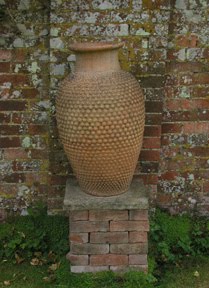
Objects can be as simple as an urn on a pedestal of old bricks.

I love it when an object is nearly hidden and you just stumble upon it when it catches your eye.

Statues have traditionally been used in the garden as a focal point, such as this statue of Pan at Pashley Place in England.

This weathered bust was found in the garden Great Comp in England...the crow seemed to enjoy it too.

Of course it takes a large garden to pull off having a life-sized chess set, such as here at Groombridge in England.

This certainly isn't your typical decorative object in the garden but I loved discovering this pile of discarded pots within a walled garden at Iden Croft Herbs in England.


An object doesn't have to be large to be decorative,  a little terra cotta toad house or even tinier fairy figurine are charming tucked in among the plants.

Imagine following the sound of water and finding this fountain on the back of a chimney among climbing hydrangeas, what could be more charming.

I found these little guys among the tall grass at Merriments Garden in England.

Sometimes you find something totally unexpected such as these graves of some beloved family pets. 

OK so I couldn't resist this found object...why does everything look better in an English garden, even a cart of weed clippings.


Wednesday, June 9, 2010

Down the Garden Path

Garden paths should be functional first and attractive second.

It can be a rude awakening to discover that beautiful winding path you just put in isn't wide enough to bring your garden cart through. Paths can lead to nowhere, they can be utilitarian or decorative, they can be made at great expense or as cheap as a bag of wood chips, it's all up to you and what you want. Materials used for a path are unlimited, grass, pavers, gravel,  bricks, slabs of stone, they can be simple and they can be complex. 

No problem getting a garden cart down this beautiful path at
Goodnestone Garden, England

Not all lawn paths have to be straight, this is a spectacular lawn at
Merriments Gardens in England

Of all the paths I've seen throughout my travels in England, this is the one I fell in love with and copied for my own. This is at the very famous
Sissinghurst Castle, England

This is how mine came out, right after completion and today.

I love this path at Bateman's in England, the home of Rudyard Kipling

It's not unusual to create a path with an assortment of materials, and having a focal point in the center, such as this at West Dean, England

This path, also at West Dean was just dirt...how come a dirt path doesn't look this good at my house?

 A very common and versatile material is flagstone as used here at Great Dixter, England (top), Great Comp, England (middle) and
Groombridge, England (bottom).

One of the most common materials used is brick and as you can see from here,
brick can be formal as here at Hole Park, England or casual as
Heasleigh, a B&B in England 

It doesn't get any cheaper or easier than this path made from wood chips,
a utilitarian path to the back of one of my gardens


Monday, June 7, 2010

Container Planting

The elements of a good container planting should:
Thrill, Fill and Spill
Container plantings can be simple or complex, the more complex should have a plant that "thrills", that's the one that is the centerpiece and usually is toward the back; "fills", would be the plant that fills in the space between the "thrill" and the "spill" which as it sounds, should spill over the sides.

Newly planted the impact is still there but as time goes by this container will dazzle. The container is actually a birdbath stand turned upside down. It's cast iron with no drainage so I always plant it with plants that love to be wet, in this case an elephant ears,  a juncus and a fiber optics plant.

A simple concrete basket holds a begonia and some impatiens.

The simple coleus is so versatile depending on what you pair it with and the container it's in.

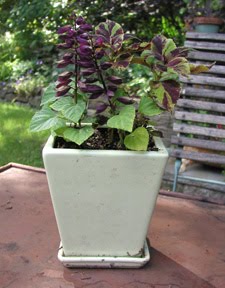
 Some purple salvia paired with a purple splashed coleus is complimented by a simple light green container.

Don't be afraid of color, this container newly painted purple is paired with a spectacular begonia, orange impatiens, nemesia and a chartreuse licorice plant which as they age will spill over and make the purple all the more vibrant.

The same container planted with the same plants, early in the season and later in the season. 

A grouping of containers,, preferably in odd numbers, can create a feeling of warmth and comfort on any patio or deck.

Friday, June 4, 2010

Lady's Mantle

Botanical Name:  Alchemilla mollis   
al-kem-ILL-ah MAWL-iss   
Common Name: Lady's mantle 


The first time I became aware of Lady’s Mantle was on a trip to England where I noticed it in several gardens and was promptly charmed by this delicate and versatile plant.

 Merriments Gardens, East Sussex, England

Lady's Mantles are attractive perennials usually grown for both their round, pleated foliage and their unusual chartreuse flowers. The plants grow between 8 and 14 inches high, with lobed leaves of silvery gray-green that bear silky hairs. The flowers appear in early summer, standing well above the leaves, and last for several weeks. One of my favorite characteristics of this plant is the way it catches the morning dew or rain on it’s leaves. It can be paired with just about any color and look outstanding.

 Water beads up on the leaves, giving the appearance of jewels
when it catches the light.

Lady's Mantles are easy to grow in average garden soil where summers are cool and moist, preferring some protection from hot sun in midsummer. In warmer parts of the country, they need a moist, fertile soil and light shade. I have several both in shade and in full sun and they all do well. This is a plant that looks best at the front of a border or draping itself over a wall. They are also great in a container planting. The flowers are a perfect filler plant in cut flower bouquets.

The plant is called Alchemilla vulgaris, in botanical circles and is actually an herb. The botanical name, Alchemilla, suggests the plant is a direct reference to the alchemists, early chemist and magicians believed that dewdrops which gathered on the leaves of the lady’s mantle had some magical powers.
 Heasleigh, a B&B on the outskirts of London, England
The plant does, however have several medicinal uses. It’s common name - Lady's Mantle was given due to the plants very shapely and pleated leaves that look like a lady's cloak in medieval times. The original common name of the herb was - Our-Lady's-mantle in honor of the Virgin Mary.

 Idiridge, a private garden in East Sussex, England

Wednesday, June 2, 2010

Ferns

You say you have a dark area in your garden that's always wet and nothing will grow there....try a fern, better yet try LOTS of ferns.

I love ferns, nothing seems to be more carefree, pest free, deer resistant and just plain lovely, I have yet to find one I don't like. Ferns are also great plants for indoor or outdoor gardening. There are types that are great for shade gardens, sun gardens, rock gardens, pond, bog gardens, flower borders and just about everywhere.

The only problem with ferns is that so many of them look alike to me and that's why I try to find the more unusual ones.

One of the most charming ferns I've found is the Autumn Fern. In early spring it emerges a gold shade of orange, then in summer turns to green and in the fall becomes a beautiful copper color.

The Cinnamon fern is so named (I'm assuming) because in early spring it sends up a shoot that resembles a cinnamon stick...unfortunately that time has passed in this shot. 

Sadly I don't have the name of this beauty, I found it in an unlabeled pot with just a single frond and I had to have it. It's taken a couple years to get to the point it is and it's been worth the wait...it's so delicate.

Who says ferns have no colors...this is a Japanese Painted Fern and it's purple and silver in color and a real knock-out in any garden.

Not all ferns are the typical fronds we think of, here is a Victorian Lady Fern and it's simply stunning and a great companion here with a hosta and a sedum.

The Lady Fern is one of the most common ferns you'll find but it's a classic.

The Bird's Nest Fern is primarily a houseplant though I grow mine outdoors in a container and winter it over in my greenhouse. It's looking a little worse for it right now because it recently came out of the greenhouse for the winter but before long it will be thick and full again.

I frankly think it's nearly impossible to kill an Asparagus Fern and that could be because it's really not a fern at all, it's a weed. This particular Asparagus Fern is a Foxtail variety which I love.
It is not winter hardy but it takes very little care to thrive.